
Salt Cell Scaling: Effortless Fix for Ugly Flakes
March 29, 2026
Chemical Storage: Ultimate Pool Safety Guide
April 1, 2026
- Organic Chlorine: Stabilized for Sunlight
- Inorganic Chlorine: Pure Power, Unstabilized
- Organic vs. Inorganic Pool Choice: Making the Ultimate Decision
Chlorine, the ultimate choice for pool sanitation, is essential for maintaining clear, clean, and safe swimming water. However, navigating the world of pool chlorine can sometimes feel overwhelming, with a variety of products on the market falling broadly into two categories: organic and inorganic. Understanding the key differences, benefits, and drawbacks of each type is crucial for making an informed decision that best suits your pool’s unique needs and ensures a healthy swimming environment.
Before diving into the specifics, let’s briefly touch upon why chlorine is indispensable. Chlorine acts as a powerful sanitizer, killing bacteria, viruses, and algae, and as an oxidizer, breaking down organic contaminants like sweat, oils, and other debris. The goal is to maintain a consistent level of “free available chlorine” (FAC) in your pool water, which is the active form of chlorine ready to do its job.
Organic Chlorine: Stabilized for Sunlight
Organic chlorine products are characterized by the presence of cyanuric acid (CYA), also known as stabilizer. CYA protects chlorine from degradation by the sun’s UV rays, making it last longer in outdoor pools. While beneficial, managing CYA levels is vital, as excessive amounts can lead to “chlorine lock,” where chlorine becomes less effective.
Two primary forms of organic chlorine are widely used:
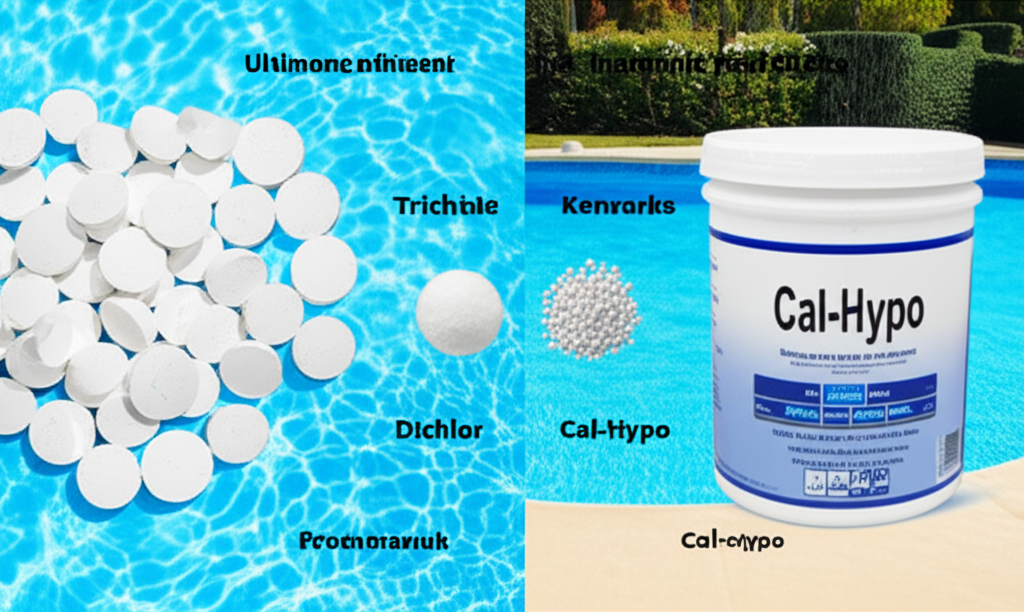
Trichlor (Trichloro-s-triazinetrione): Often found in slow-dissolving tablets, sticks, or granular forms, Trichlor is a highly concentrated chlorine source (typically 90% available chlorine).
Pros: Its slow-dissolving nature makes it convenient for continuous chlorination, often used in automatic feeders or floating dispensers. The built-in CYA provides excellent UV protection, extending chlorine’s lifespan.
Cons: Trichlor is highly acidic (pH around 2.8), meaning its regular use will significantly lower your pool’s pH, requiring frequent adjustment with a pH increaser. It also steadily contributes to CYA levels, which can accumulate over time and necessitate draining/dilution to bring levels back into range (ideally 30-50 ppm, never exceeding 80 ppm).
Dichlor (Sodium Dichloro-s-triazinetrione): Available as fast-dissolving granules, Dichlor typically contains 55-62% available chlorine. It’s often used for shocking or daily chlorination in smaller pools or spas.
Pros: Dichlor dissolves quickly and is nearly pH neutral (pH around 6.7), making it less impactful on water balance than Trichlor. Like Trichlor, it contains CYA for UV protection, making it effective for regular use. It’s a popular choice for initial chlorination and quick boosts.
Cons: While less acidic than Trichlor, it still contributes to CYA buildup. Its lower chlorine concentration means you might need to use more product to achieve the same sanitizing power as Trichlor.
Inorganic Chlorine: Pure Power, Unstabilized
Inorganic chlorine products do not contain cyanuric acid. This means they are highly potent and fast-acting, but also more susceptible to degradation by UV rays. They are ideal for shocking, indoor pools (where UV isn’t an issue), or outdoor pools where strict control over CYA levels is desired.
The most common inorganic chlorine type is:
Cal-Hypo (Calcium Hypochlorite): Sold in granular, tablet, or stick forms, Cal-Hypo is a powerful oxidizer, typically containing 65-75% available chlorine. It’s frequently used for shocking pools to super-chlorinate and eliminate strong contaminants or algae.
Pros: Cal-Hypo is a very effective sanitizer and oxidizer. It does not introduce CYA into the water, giving pool owners complete control over stabilizer levels. It also adds calcium to the water, which can be beneficial in pools with low calcium hardness.
Cons: Cal-Hypo is highly alkaline (pH around 10.8), meaning its use will significantly raise your pool’s pH, requiring adjustment with a pH reducer. It also adds calcium hardness, which, if not monitored, can lead to scale formation on surfaces and equipment in areas with already hard water. It needs to be pre-dissolved before adding to the pool to prevent cloudiness or bleaching of liners, and it’s unstabilized, meaning it depletes quickly in direct sunlight.
(Briefly worth mentioning, Sodium Hypochlorite, commonly known as liquid bleach or liquid chlorine, is another inorganic option. It’s effective, raises pH, and contains no CYA, but is unstabilized and has a shorter shelf life.)
Organic vs. Inorganic Pool Choice: Making the Ultimate Decision
When considering your organic vs. inorganic pool choice, several factors come into play:
1. Pool Type and Location:
Outdoor Pools: Organic chlorine (Trichlor, Dichlor) is often preferred for daily sanitation due to its built-in UV protection via CYA, which drastically reduces chlorine loss to sunlight.
Indoor Pools: Inorganic chlorine (Cal-Hypo, liquid chlorine) is ideal as UV degradation is not a concern, allowing for precise chlorine management without introducing CYA.
Shocking: Inorganic options like Cal-Hypo are popular for their fast, powerful action when shocking both indoor and outdoor pools, especially when a quick, high dose of unstabilized chlorine is needed.
2. Water Chemistry Impact:
pH: Trichlor lowers pH, Cal-Hypo raises it, and Dichlor is relatively neutral. Your choice will influence how frequently you need to adjust pH.
CYA Levels: Use of Trichlor and Dichlor will steadily increase CYA. If CYA gets too high, chlorine becomes sluggish. Cal-Hypo introduces no CYA, giving you full control to add it separately if desired.
Calcium Hardness: Cal-Hypo adds calcium, which can be beneficial in soft water areas but problematic in hard water areas.
3. Convenience vs. Control:
Organic chlorine often offers more convenience for daily maintenance (especially Trichlor in feeders/floaters) due to its extended lifespan.
Inorganic chlorine, while requiring more active monitoring (especially for pH and sunlight), offers precise control over CYA levels and can be crucial for addressing specific problems like algae blooms rapidly.
4. Maintenance Style: Are you a “set it and forget it” type (within reason), or do you prefer hands-on, precise water chemistry management?
Ultimately, there isn’t a single “ultimate” choice that fits all pools perfectly. Many pool owners successfully employ a hybrid approach: using organic chlorine (Trichlor or Dichlor) for daily ongoing sanitation and inorganic chlorine (Cal-Hypo) for shocking or when CYA levels need to be managed.
The most important takeaway is to regularly test your pool water for free chlorine, pH, alkalinity, calcium hardness, and especially cyanuric acid. Understanding how each chlorine type influences these parameters empowers you to make educated decisions that maintain optimal water balance, ensuring a sparkling clean and safe swimming experience for everyone.